A smooth sea never made a skilled sailor. ― Franklin D. Roosevelt
I love programming. But I haven’t always loved programming at work. Programming is fun but some companies will always find ways to make it boring. Learning becomes less natural when working in such environments, but learning must never stop. There are always opportunities to learn. This article will give you my tips.
Learning in Hostile Environments Is Possible
Even when life is difficult or challenging — especially when life is difficult and challenging — the present is always an opportunity for us to learn, grow, and become better than we’ve ever been before. ― Hal Elrod, The Miracle Morning
Robert Greene says we always have a choice between alive time and dead time. Dead time is when you’re sitting around waiting for things to happen to you, and alive time is when you’re in control, making every second count, improving, learning, and growing. We always have to make the most of whatever is in front of us, as others have done before us.
Learning in jail with Malcolm X
Malcolm X was barely literate when he was imprisoned. He requested a dictionary from the prison library and spent months copying it by hand to expand his vocabulary before starting to read every book he could get his hands on. Books made him “free.”
Learning in prison camp with James Stockdale
Admiral James Stockdale turned his seven and a half years in a prison camp into a laboratory to experiment with Stoic philosophy that he had studied when he was younger. Stockdale realized that optimists were the first to die. He discovered that surviving requires maintaining an unwavering faith that suffering will end, while simultaneously having the discipline to face the brutal reality. This is now known as the Stockdale Paradox.
Learning during an epidemic with Isaac Newton
Isaac Newton did some of his best research when Cambridge closed due to the plague, when he retreated to his family home. During this two-year period, free from distractions, he developed his theories on calculus and also realized that white light is composed of a spectrum of colors. I was clearly not as productive during COVID-19 lockdowns…
Learning during boring jobs with Albert Einstein
Albert Einstein did not develop his theories while working in a prestigious university. Instead, he did it while working full-time as a clerk at the Swiss Patent Office. Einstein was so good at reviewing patent applications that his work was usually done by the afternoon. He spent the rest of his shift thinking about his theories and published four papers that completely changed physics during that time. A great example of making time alive.
Learning during parenthood with Toni Morrison
In the late 1960s, Toni Morrison was a recently divorced single mother of two small boys, working full-time as an editor. Because her days were consumed by her job and her evenings by her children, she realized the only time that belonged to her was before the world woke up. She began writing at 4 AM every morning, but also scribbled notes while sitting on the curb, or during her commute. Motherhood made her a better writer because it forced her to be efficient. She didn’t have the luxury of “writer’s block.”
What all of these examples teach us is that we can always learn and grow, if we decide to. The good news is that we don’t have to go to jail to learn. The bad news is that we probably don’t have as much uninterrupted time as prison provides. What we need is a similar mindset as captured in those stories to create opportunities in our current environment.
But first we have to accept a hard truth.
Finding Meaning in Hostile Environments Is (Almost) Impossible
Consider the story of two stonemasons. You walk up to the first stonemason and ask, “Do you like your job?” He looks up at you and replies, “I’ve been building this wall for as long as I can remember. The work is monotonous. I work in the scorching hot sun all day. The stones are heavy and lifting them day after day can be backbreaking. I’m not even sure if this project will be completed in my lifetime. But it’s a job. It pays the bills.” You thank him for his time and walk on. About thirty feet away, you walk up to a second stonemason. You ask him the same question, “Do you like your job?” He looks up and replies, “I love my job. I’m building a cathedral. Sure, I’ve been working on this wall for as long as I can remember, and yes, the work is sometimes monotonous. I work in the scorching hot sun all day. The stones are heavy and lifting them day after day can be backbreaking. I’m not even sure if this project will be completed in my lifetime. But I’m building a cathedral.” — Simon Sinek, Give ’em a cathedral
Some people have a dream job. They wake up every day eager to work on a problem they care about in an environment that brings out the best in them. But most don’t. Some of us operate in a broken culture preventing the right decisions to win over the bad ones. Some of us accept a job to pay rent and buy groceries for their family. Some of us have to stay in a specific town to care for relatives. Some of us have to “choose” a career matching market demand. Moreover, a majority of companies will never have a meaningful “why.” Sometimes, you just have to build a house like any other house…
Recent studies report that more than 80% of workers are dissatisfied (or hate) their job. Many jobs are indispensable but it’s not because they are useful that they are meaningful. Collecting trash is indispensable for humans to live healthy in a city, yet it is often socially devalued. Similarly, many software applications are indispensable without being meaningful for its developers. Meaning is a scarce resource compared to necessity. Being useful at work is a preferable goal than searching desperately for meaning.
In addition, we are the first species to question the meaning of life and we have only recently tried to find it at work. For a very long time, we worked to survive, not to prove our identity. If some can find meaning at work, everyone must find meaning outside of work. The workplace is a volatile environment. A dream job can transform into a nightmare job overnight when facing burnout. And every day companies die, making some dream jobs a ghost of the past.
How to Learn in Hostile Environments
Step 1: Empty the Cup
The goal of this first step is to keep your head above water.
Work Less, Produce the Same
If you fail to find meaning in your work, working longer hours will not bring greater meaning.
The phenomenon named “quiet quitting” urges individuals to decouple their identity from their work. But if you have a growth-mindset, that couldn’t be the solution, unless you are resigned to stay in your environment, which you must not! A preferable approach is to get better at what you do to spend fewer hours producing the same output, similarly to what Einstein did when reviewing patents. Productivity textbooks like Atomic Habits are full of practical techniques to try. Find what works for you. I often work using pomodoros to fight procrastination and I try hard to ignore gossip, which is so prevalent in toxic environments, but which is also a trap for dead time.
Find Meaning Elsewhere
We all have different roles in life – parent, spouse, worker, mentor, friend. Every role has the potential to bring meaning in your life like spending quality time with your kids and seeing them naturally enjoy life.
We all have different passions in life. While it’s great to be paid for your passion (the myth of the dream job we discussed earlier), it’s also great to just experience passion for free. Find a hobby (or something you liked to do when you were a kid) and go through your day looking forward to your hobby.
In short, you must not just find meaning elsewhere, you must seek meaning everywhere, while expecting it from anywhere. This will remove some pressure and by lowering the expectations for your work, you are making it possible to better accept your situation and overcome it.
Step 2: Fill the Mind
The goal of this second step is to use your “meaningless” time to fuel “meaningful” activities.
Learn from Failures
I sought good judgment mostly by collecting instances of bad judgment, then pondering ways to avoid such outcomes. – Charlie Munger
What is great about hostile environments is that you will face more failures than successes. It’s an opportunity, seriously. It’s a lot easier to learn from mistakes than from successes. There are always decisions or actions that could explain a failure. It’s not true for success. Luck plays a crucial role. You may interpret some events as important when they weren’t, and inversely.
Therefore, use your time to reflect on failures. Observe what is not working. Ask questions. That’s how experience is built, through reflection.
Learn Through Others
Everyone has something to teach you, even if neither of you realizes it. The catch is: it’s not their job to show you, it’s your job to figure out what you can learn. ― Mark Manson
It feels counterintuitive to look for others when you’re surrounded by people you’d rather avoid, but a broken company is actually a goldmine for observation.
You may not learn what to do from others, but at least, you can learn what not to do. I’ve developed my intuition on many topics like leadership from observing bad leaders. When someone handles a situation poorly, perform a post-mortem in your head, try to understand where things go wrong and what could have been done and what could be done differently. Read books or articles on the subject.
In addition, there is at least one other person who feels the same way you do. Share your reflections together like mutual therapy sessions. It really helps.
Learn Soft Skills
Technical skills can be taught but who you are as a person—how you think, how you act, and how you interact—these emerge over years and change slowly. […] Soft skills distinguish junior from senior employees. – Austen McDonald, former Hiring Committee Chair at Meta
I’ve always joined companies with the intent of improving my hard skills. I’ve (almost) always left them with the feeling of not having improved them that much and the feeling of having improved my soft skills so much.
Hostile environments are challenging. For example, decisions are painfully made. They are subject to politics, to conflicting opinions (which is great), conflicting personalities (which is bad), overbearing egos, etc. As we need obstacles to grow in life, hostile environments provide a great playground to learn more about yourself.
There are so many skills that can be improved in any environment. How to communicate your ideas clearly. How to manage conflicts. How to listen actively to coworkers. For example, I’ve always used my work experiences as a school to practice Stoic philosophy, trying to get better at focusing exclusively on what I control.
There is also a single skill that you must definitely master (and that I haven’t). You must know when to give up, when the cost of staying outweighs the benefit of the experience, which brings us to the last point.
Step 3: Move Forward
The goal of this last step is to emerge from your current experience stronger than ever.
Rewrite the Story
In psychology, reframing consists in changing the way a situation is perceived from a different perspective—one that is more constructive. This concept is similar to a core Stoic principle – while we cannot change the facts of our lives, we can change the meaning we assign to them, which in turn changes our emotional response.
I’ve used my blog as a sanctuary. I wrote blog posts to turn bad experiences into constructive ones (and I still have a long list of similar posts to write!). I sometimes write to say what I cannot say at work. If your environment isn’t the best place to share your ideas, a blog post offers a different audience. And even if nobody is reading, you still have rewritten the story.
Find a new job
Even if learning is always possible as we have seen, working in a stressful environment is not sustainable indefinitely. Sooner or later, you will apply for a new job. From my experience, I’ve always waited too long and wasted precious months that I could have spent elsewhere in a more friendly environment. One of the reasons is that despite my morale going down, I’ve always found ways to continue learning. I tried to document them in this blog post but beware that these techniques must not be used to postpone your career change if you can.
Conclusion
It is a strange paradox, that many of the clearest, most comforting life lessons are learned while we are at our lowest. […] We grow through hard times. Growth is change. And when everything is easy, we have no reason to change. – Matt Haig, The Comfort Book
A smooth sea never made a skilled sailor, for sure, but nobody could survive turbulent water for too long.
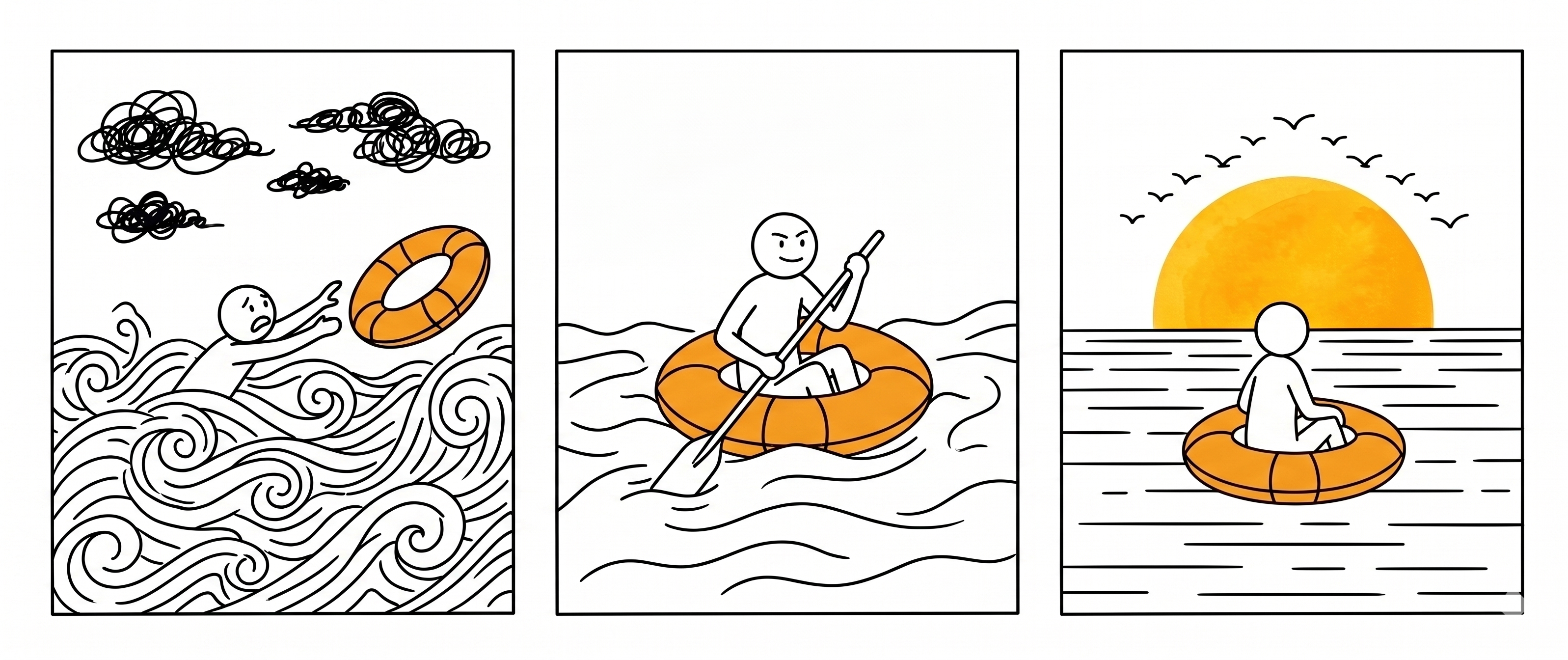
- First, put on your life jacket and reduce your hours to stay afloat. You must make time to prepare a better future.
- Second, use difficult moments to build your character. You must learn what could be learned.
- Third, prepare for a new destination. You must always look at the horizon for calmer water.
Learning is a journey made of obstacles. There are no wrong work experiences. As long as you are moving, you are learning. There are shorter paths, for sure, and many dangerous paths where learning becomes more difficult. But learning is always possible. The more hostile the environment, the more you need to be active in learning.

About the author
Julien Sobczak works as a software developer for Scaleway, a French cloud provider. He is a passionate reader who likes to see the world differently to measure the extent of his ignorance. His main areas of interest are productivity (doing less and better), human potential, and everything that contributes in being a better person (including a better dad and a better developer).
Read Full Profile