We, nonfiction readers, are an endangered species. Sadly, WWF does not care about us. Not enough people read nonfiction books but those who do sometimes read too much. We challenge ourselves to read a given number of books before the end of the year, and if there are good reasons to read more (and many articles to help), there are also good reasons to read less.
Why?
Reading is motion. Doing is action.
Life is basically a succession of projects. Books are invaluable during that journey but reading alone doesn’t guarantee progress. You will find solutions to questions you have and ideas to try, but reading becomes useful only when knowledge is turned into action. Reading one more book when you’ve already enough information to move on is not productive. Reading must not become a form of procrastination.
Reading is entertaining. Even boring nonfiction.
Reading a nonfiction book is entertaining even if you learn a lot in the process. But we aren’t born on a tiny planet lost in a huge universe to amuse ourselves to death. Even for introverts like me that enjoy reading so much, our life cannot revolve around reading. Reading must not become a source of distractions from our goals.
Reading is time-consuming. Time is limited.
Books are stealing our time. Reading more and more books means having less and less time for other activities – a personal project you haven’t started, a training session, or just time you could spend with your kids. And reading a book seriously takes even more time. You need to take notes, process them, and review them again, and again. Reading must not become an excuse to not live your life.
How?
The goal is therefore to limit the time spent reading books but not necessarily the impact books can have on you.
Read later
When finding a great, exciting, new book, pause. Wait a few weeks and reconsider the decision to buy, borrow, or ignore the book. During that time, you will have found other books and you’ll be in a better position to objectively decide if you really need this one. Let time sort out the books for you.
✓ Create a sorted reading list and review it regularly.
Read for discomfort
Resist confirmation bias. We love being proved right and so we love reading books that confirm what we think. Reading must not be comfortable. Reading must be challenging. The goal is to read more broadly on unfamiliar topics and more deeply on familiar ones. The goal is to face controversial ideas. The goal is to learn what you weren’t looking to learn.
✓ You must be driven by ideas, not by repetitions.
Read for immediate action
The problem with curiosity is that you will want to learn about everything during a very limited timeframe that we call life. Our brain is not wired to remember everything so learning about everything is not a great idea. Most of what you will learn will be forgotten before you even notice it.
Learning must always be a step towards action. You aren’t learning for learning. You are learning to think or do differently. It’s better to read parenting books when you cannot sleep at night because your newborn demands his pacifier again and again. It’s better to read philosophy books after having met your first life challenge. Wait to have an opportunity to apply what you want to learn.
✓ Find actionable books.
Read for the long-term
Knowledge, like food, will rot. Especially at work, you may be tempted to learn about new trends… continually. Except most of the trends are just waves. You must care about deep water. For example, in software development, it’s better to have a solid understanding of design patterns than being familiar with a lot of frameworks, especially if these frameworks address the same problem. It’s better to focus on core principles and timeless teachings like Stoic philosophy rather than trying to read every new self-help book that presents the same old information differently. Read for your future self.
✓ Learn to evaluate the expiration date of books.
Read actively
Reading less but remembering more is preferable to reading more and remembering less. Annotate your books. Finish every chapter by asking yourself questions: How to use the information right now, in a year, in 10 years? Gather your notes. Write a review. Share the book. Reread your notes later. Let books shape who you are.
✓ Choose a book when you’re ready to engage with it.
Read long-lasting best-sellers
Resist books that ranked immediately on the New York Times Best Sellers. Marketing works, only temporarily. The best books that stayed a long time on such lists rely on word-of-mouth. It takes time. Some books such as Atomic Habits landed immediately on the list but it’s more the exception than the rule. Many books made it onto the list after a lucky event, like when Oprah Winfrey recommended The Power of Now by Eckhart Tolle. Differentiate commercial from perennial successes.
✓ Trust word-of-mouth more than marketing.
Read and stop
You don’t have to complete every book you read. You don’t even have to read this post to the end (but I think it’s better to practice on your next book 😅). It’s the author’s job to captivate you. If you read a lot and a book feels like a burden, it’s not your fault. Stop. Give your attention to authors that deserve it.
✓ Acknowledge boredom.
Summary
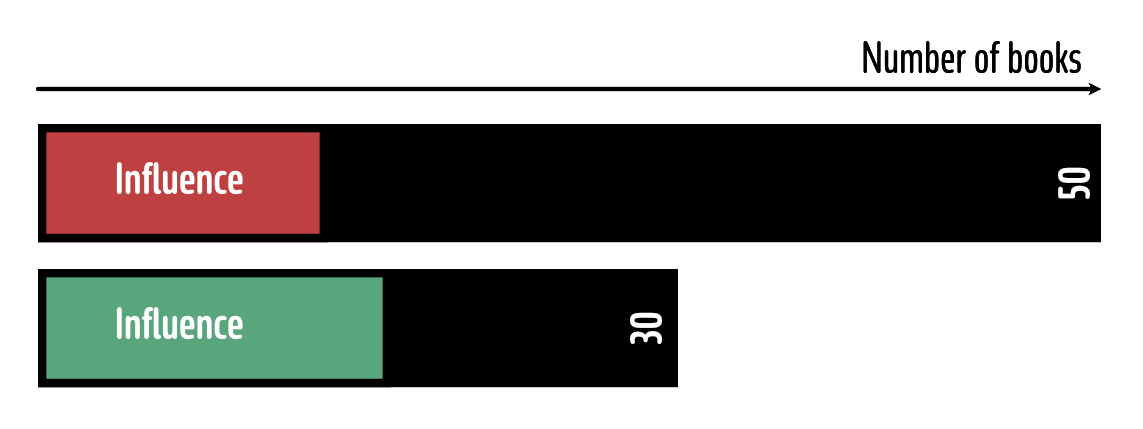
Keeping a log of all the books I’ve read helps me reflect on which books have a truly lasting impact on me. Most of what I’ve read wasn’t as insightful as imagined. Most of what I was eager to read is now long forgotten. Reading more is not the solution. Reading fewer books, on purpose, and with purpose is the solution.
I think 30 books per year is a great target but not a good goal. What you absorb and how you are changed is more important. I often look back at my one-year-younger self and notice how much I have changed. Reading is about becoming. You don’t need a lot of books for that.
About the author
Julien Sobczak works as a software developer for Scaleway, a French cloud provider. He is a passionate reader who likes to see the world differently to measure the extent of his ignorance. His main areas of interest are productivity (doing less and better), human potential, and everything that contributes in being a better person (including a better dad and a better developer).
Read Full Profile