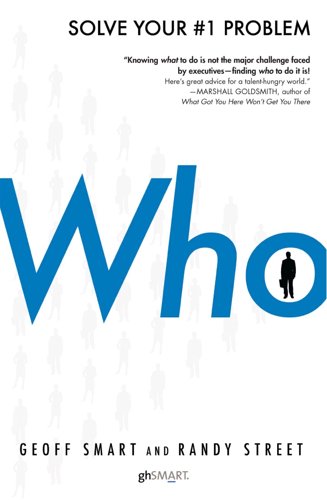
WHO must read this book? Anyone who is still not convinced that hiring is the most important decision.
Every tech problem is a people problem — and every people problem is a hiring problem.
I have always been convinced that hiring is the most important decision a company makes (and the most important skill for a software developer as recommended by Eric Schmidt and Jonathan Rosenberg in How Google Works).
Published in 2008, Who: The A Method for Hiring is maybe the first book to make such a strong argument about hiring, focusing on who you embark on your journey with, rather than what you are going to build. Tim Ferriss, author of iconic titles like The 4-Hour Workweek, even bought a copy for every startup he joined. Ed Catmull, founder of Pixar, famously said, “Give a good idea to a mediocre team, and they’ll find a way to screw it up. Give a mediocre idea to a good team, and they’ll find a way to make it better.” Hiring A players is not a guarantee of success, but it is certainly a key ingredient, especially since A players attracts other A players when B players hire C players, as expressed by Steve Jobs.
While the core message of the book is undeniable, I disagree with their “A method” itself — their four-step process. For example, the authors emphasize the role of reference checks (by conducting more than five ones!). I think it’s a bad thing. It fosters the Matthew Effect where interesting past experiences provide a head start that leads to further great new experiences, effectively making “the great candidates become even greater.” It also ignores the Lewin equation telling us that human behavior is a function of the person and their immediate environment. If you change the environment, you change the person, and in a Western world where over 80% of people don’t like their job, ignoring this principle is definitely not a good strategy. Hiring the best means also considering the ones that weren’t as lucky in the past, for example, due to family obligations that prevent them from landing in the right work environment, or due to cognitive bias that deny them the opportunity to express their talent.
In addition, the book was published before the rise of large corporations like Google. We need to reconsider the book content to learn from these large companies having hired so many talented people during the last two decades. Who is for sure the most impactful decision you can take for your company, your project, your team (and even your life) but who is wrongly depicted in this book. Read the book to understand the goal and iterate to reach it.

About the author
Julien Sobczak works as a software developer for Scaleway, a French cloud provider. He is a passionate reader who likes to see the world differently to measure the extent of his ignorance. His main areas of interest are productivity (doing less and better), human potential, and everything that contributes in being a better person (including a better dad and a better developer).
Read Full Profile